
Reducing the interval length may be better?
A study looking at interval desgin to determine the most effective way to improve VO2max was released.

Every athlete and coach is obsessed with trying to get the most adaptations from a single session/s. Often this can mean redesigning intervals or full training weeks to maximise the adaptations. But the sad reality is that there is no one magic way to improve or maximise oneself. It is the combination of multiple workouts over a long period that results in the best outcome. Having said that, research continues to determine which intervals are more effective in maximising adaptations to ensure athletes work in the right direction.
In a previous Substack article, I looked at the most effective intervals for VO2max development (here). However, I missed a study I recently found which provides a new way of designing these types of intervals.
Traditionally, we have been told the best VO2max intervals are 4 x 4 minutes at which gives enough time for our heart rate to reach above 90% of our VO2max. The problem is that power tends to decline towards the end of the intervals, meaning the desired output to achieve the desired adaptations is not completely fulfilled. This opened the door to shorter intervals. Newer research then established that 3 x 10 x 30 seconds increases the amount of time spent above 90% of VO2max compared to longer intervals, in theory making these more effective. Now, there may be an even better way to increase time above 90% of our VO2max.
The evidence:
A research group in Italy (Vaccari, F. et al 2020) recruited 12 amateur cyclists aged 41 ± 11 years with a VO2max of 4.32 ± 0.47 L/min. Each participant completed three different types of intervals.
Short Intervals: 30 seconds at high intensity, 20 seconds easy.
High-intensity decremental intervals (HIDI): 3 mins hard, 2 mins easy, 1 min hard, 40 secs easy, 40 secs hard, 27 secs easy, 30 secs hard, 20 secs easy.
Long Intervals: 3 minutes at high intensity, 2 minutes easy.
The power output sustained was the equivalent of the 5-minute peak power of the athletes. In this case, that was on average 117 ± 6% of critical power (similar to FTP). The easy rest intervals were at 83 ± 6% of critical power. Intervals continued until the participants reached exhaustion. The design of the intervals can be seen below.
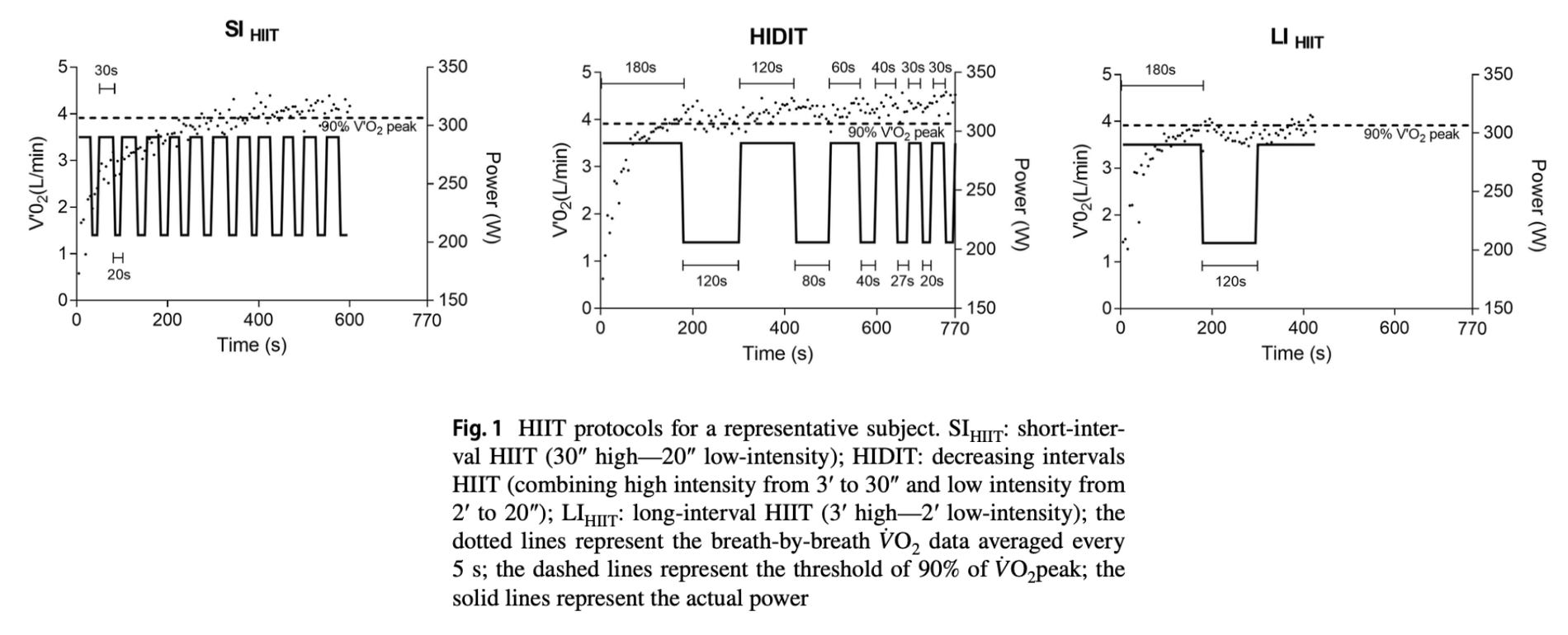
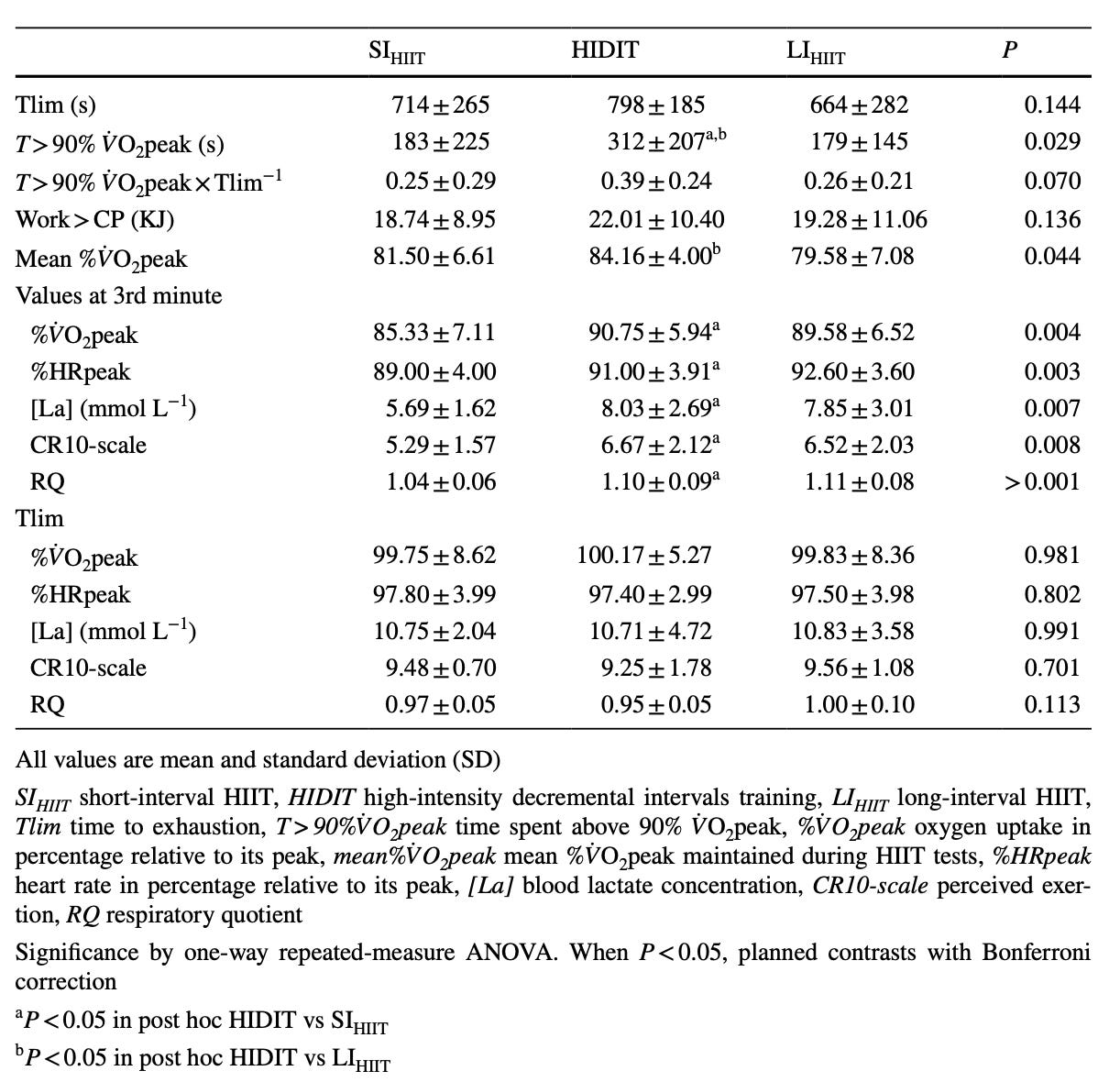
Time spent above 90% of VO2max was significantly higher in the HIDI (312 ± 207 seconds) compared to short (183 ± 225 seconds) and long intervals (179 ± 145 seconds). Although it could be said this is the result of the HIDI sessions lasting longer on average (798 ± 185 seconds, short intervals = 714 ± 265 seconds, long intervals = 664 ± 282 seconds), the percentage of time spent spent above 90% of VO2max was much higher (39% compared short and long intervals, 26% and 27%). Plus, the interval time duration was not significantly different.
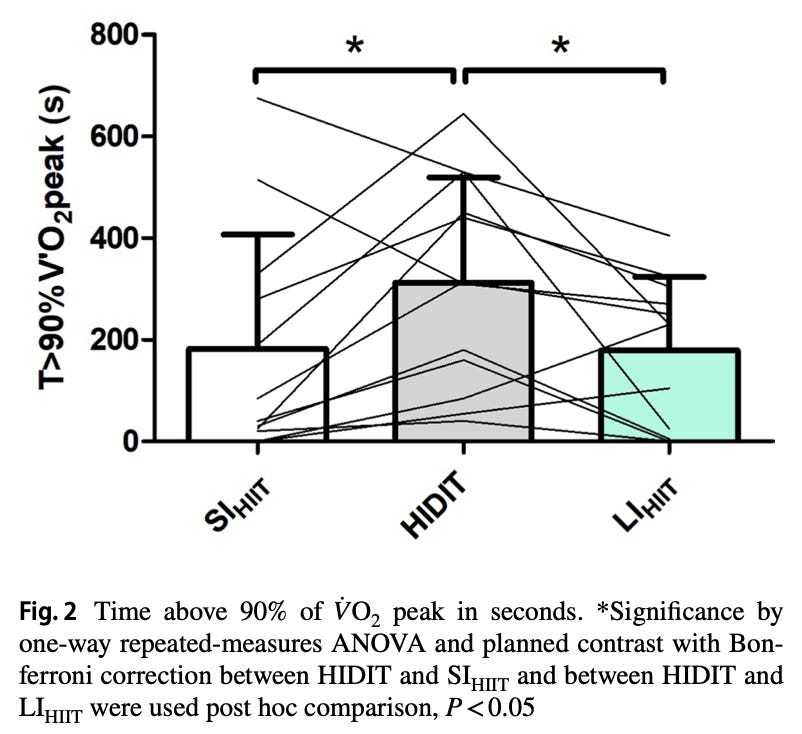
The authours cite one of the reasons these types of intervals (HIDI) were the most successful was the desgin allow for the decline in power to diminish. Therefore, allowing the cyclists to ride the required intensity to get more time above 90% of VO2max. Notably, the RPE (CR 10-scale from the table below) showed no differences, meaning athletes can get potentially more benefit for the same perceived effort.
However, there are some caveats to mention. These intervals assume the athletes go to failure; for an everyday amateur athlete, it is not practical to plan a session which does not have a time frame. Not to mention going to complete exhaustion during an interval session is not necessarily best for long-term health. So, although these results look good, they may not be suitable for the masses.
The practice
This section is the same as the other VO2max interval article; however, I have now added the intervals from this study. Keep in mind that the rep frequency, rest duration, and even the interval length can be changed depending on the individual.
Micro-VO2max Development Intervals: 3 x 10 x 30 seconds at 115-125% of FTP with 15-30 second recoveries.
Medium Length VO2max Intervals: 4 x 4 minutes at 110-120% of FTP, with 4 minutes recovery (work to rest ratio of 1:1)
Supra-Threshold VO2max Intervals: 3 x 7 minutes at 105-110% of FTP with 4-minute recoveries.
Pre-Rep Medium Length VO2max Intervals: 4 x 30 seconds at 120% of FTP followed by 4 minutes at 110% of FTP with 4-minute recoveries.
Variable Intensity VO2max Intervals: 4 x 6 minutes at 105% of FTP with 30-second bursts every 1.5 minutes at 120% of FTP and 2.5 minutes of recovery.
High-Intensity Decremental Intervals: 1 x 3 mins (2 mins rest), 1 x 2 mins (80 secs rest), 1 x 1 min (40 secs rest), 1 x 40 secs (27 secs rest), 1 x 30 secs (20 secs rest) and continued until exhaustion.
You can try these intervals using the fixed intensities provided, or you can try using the self-paced method. In a given VO2max block, rotate between these 5 intervals and when progressing the training, manipulate the rep frequency or the rest duration, but less so the intensity of the workouts.
If you have any thoughts or questions, feel free to drop them in the comments.
Thanks, Jonathan